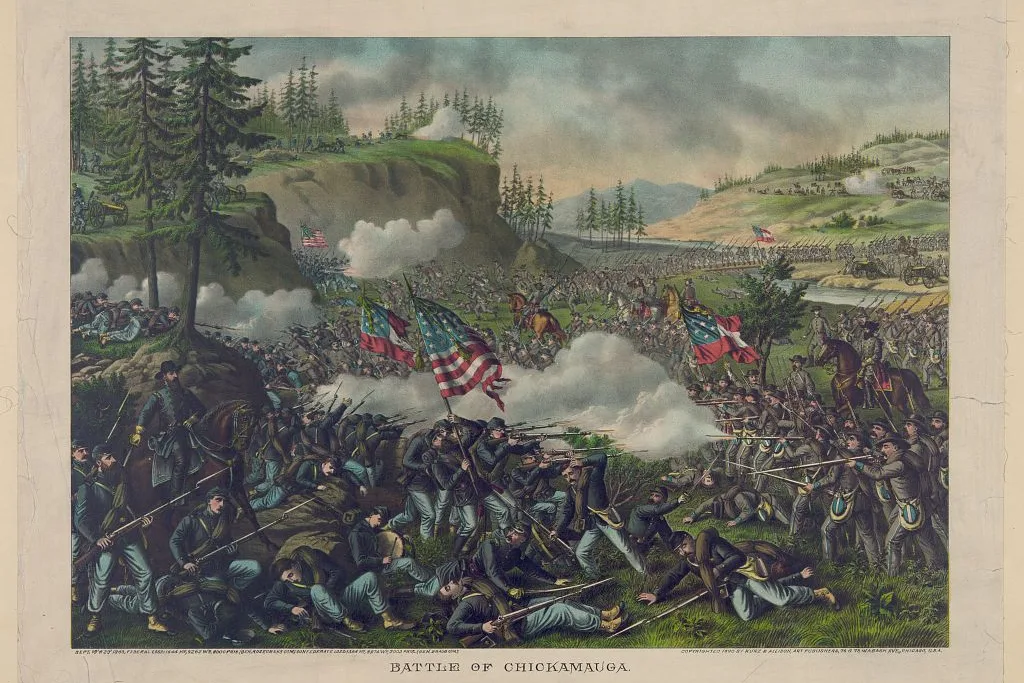
Two hours southeast of Nashville, on both sides of the Tennessee and Georgia line, lies the oldest national military park in the country and some of the most dramatic ground of the Civil War. In the fall of 1863, the armies fought for Chattanooga, the rail hub that one side called the gateway to the Deep South. The result was a pair of battles that make an unforgettable weekend for a father and a teenage son.
The park
The Chickamauga and Chattanooga National Military Park was established in 1890, the first and largest of the national military parks authorized in that decade, and a model for those that followed. Union veterans led the effort to create it. Today the National Park Service manages several units around Chattanooga, including the Chickamauga Battlefield in Georgia, Lookout Mountain and Point Park, and Missionary Ridge.
Plan on one day for Chickamauga and one for Lookout Mountain and Missionary Ridge.
Day one: Chickamauga
On September 18 to 20, 1863, Confederate and Union armies collided in the woods along Chickamauga Creek. According to the American Battlefield Trust, the battle produced about 34,600 casualties, making it the second bloodiest battle of the war after Gettysburg and the deadliest in the Western Theater.
The Confederates won the field. A gap opened in the Union line, and much of the Union army was swept away. What saved it from destruction was one general. George Thomas gathered scattered troops on Horseshoe Ridge and Snodgrass Hill and held until dark, earning the name “the Rock of Chickamauga.”
What to do: Start at the visitor center, then drive the tour road and walk up Snodgrass Hill. Stand where Thomas’s men stood and look down the slopes they defended.
What to talk about: Steadiness. When everything around him was collapsing, Thomas did not panic. He held. Ask your son what kind of man can do that, and how a boy becomes one.
Day two: Lookout Mountain and Missionary Ridge
After Chickamauga, the defeated Union army retreated into Chattanooga and was besieged there. Two months later, reinforced and under Ulysses S. Grant, it broke out.
On November 24, 1863, Union troops fought their way up the slopes of Lookout Mountain, in a battle remembered as the Battle Above the Clouds because of the fog that wrapped the mountain that day. The next day, Union soldiers assaulted Missionary Ridge and, in one of the most famous moments of the war, kept climbing past their initial objective to take the crest.
What to do: Visit Point Park at the top of Lookout Mountain, where the view over the Tennessee River and Moccasin Bend explains in a single glance why Chattanooga mattered. Then drive the length of Missionary Ridge, where monuments and markers line the road.
What to talk about: Initiative and discipline. The men who kept climbing Missionary Ridge acted beyond their orders and won. Other times in war, men who acted beyond orders caused disaster. When should a man follow orders exactly, and when should he use his judgment? There is no simple answer, and that is exactly why the question is worth asking.
Making the most of the weekend
- Read before you go. An hour on the campaign the week before transforms the visit.
- Walk the ground. Leave the car at every major stop.
- Pick one soldier. Many monuments name regiments from Tennessee, Georgia, Ohio, Indiana, and beyond. Pick one regiment and follow its story.
- Honor the dead on both sides. Tens of thousands of men were killed or wounded here. The park is a cemetery as much as a classroom.
More in Chattanooga
Chattanooga is also one of the best outdoor cities in the South. A second or third day can include hiking or whitewater, as we describe in our guide to outdoor adventures near Chattanooga.
For men who live in the area, Meriwether Academy’s Chattanooga chapter of the Meriwether Men’s Book Club meets weekly to read Plutarch’s Lives, a book full of battles and the men who fought them. Meeting details are sent by email after signup.
Closer to home, our guide to Civil War battlefields near Nashville covers Franklin, Stones River, Fort Donelson, and Fort Negley, and our guide to teaching history to a teenage boy explains why standing on the ground matters so much.
From the Meriwether archive: This Document Changed Western Civilization Forever and The Founding of Nashville: The Donelson Voyage and the Winter March That Built a City.