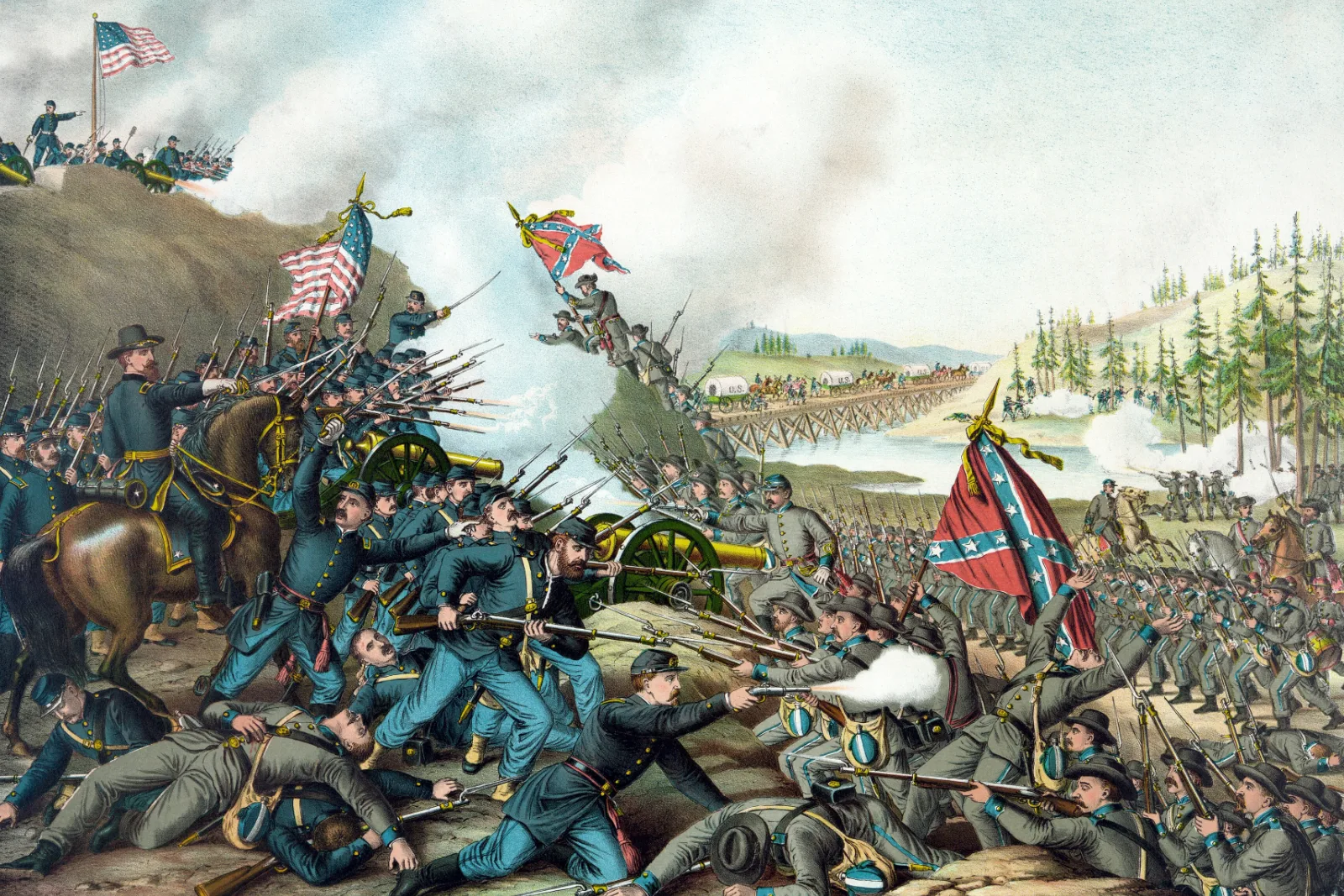
A textbook can tell a boy that thousands of men died at Franklin. Standing at the edge of the open ground they crossed tells him something no textbook can. Middle Tennessee was fought over for most of the Civil War, and the Civil War battlefields near Nashville, all within an hour or two of the city, are some of the most significant in the country. Walked with a father who has done a little reading, they become the best history classroom a boy will ever sit in.
Here are four, in the order the fighting happened.
Fort Donelson (February 1862)
About ninety minutes northwest of Nashville, near Dover, Fort Donelson is where the war in the West turned early. Between February 13 and 16, 1862, Union forces under Ulysses S. Grant besieged the fort on the Cumberland River. When the Confederate commander, Simon Buckner, asked for terms, Grant replied that “no terms except unconditional and immediate surrender can be accepted.” Some 13,000 Confederate soldiers surrendered, and the victory opened Tennessee’s rivers to the Union and made Grant a national figure. Nashville fell within weeks.
What to talk about: How a single decision by one commander, and one sentence, can change the course of a war and a man’s life.
Fort Negley (built 1862)
Right in the city, off Interstate 65 near the Adventure Science Center, Fort Negley is the easiest site to visit and one of the most overlooked. According to Metro Parks, it was built in 1862 by more than 2,700 conscripted laborers, most of them formerly enslaved people and free Black men, and it is the largest inland stone fortification built during the war. Its guns supported Union forces during the Battle of Nashville in December 1864. A visitor center tells the story of occupied Nashville.
What to talk about: Who did the work. The men who built the fort are rarely named in histories of the war, and a boy should know they were there.
Stones River (December 31, 1862 to January 2, 1863)
Just outside Murfreesboro, about forty minutes southeast of Nashville, the Battle of Stones River involved some 81,000 soldiers and produced nearly 24,000 casualties over three days. The Union held, and Lincoln called it a hard earned victory at a moment when the North badly needed one. The national battlefield includes a visitor center, a driving tour, a national cemetery, and the Hazen Monument, one of the oldest surviving Civil War monuments.
What to talk about: Endurance. Stones River was not won by brilliance but by men who held their ground for three days in winter.
Franklin (November 30, 1864)
Twenty miles south of Nashville, Franklin is the hardest of these sites to visit and the most important for a boy to see. In the late afternoon of November 30, 1864, Confederate General John Bell Hood ordered his army across roughly two miles of open ground against entrenched Union troops. The American Battlefield Trust counts about 6,250 Confederate casualties in a few hours of fighting, and fourteen Confederate generals were killed, wounded, or captured, more than in any other battle of the war.
The Battle of Franklin Trust operates the Carnton and Carter House sites. Carnton, the McGavock family home, served as the largest field hospital in the area. The morning after the battle, the bodies of four Confederate generals, including Patrick Cleburne, lay on its back porch. The family later gave two acres for a cemetery that holds nearly 1,500 Confederate dead.
What to talk about: Orders and judgment. Was Hood’s attack courage or folly? What does a man owe to an order he believes is wrong? These are questions a teenage boy is ready for, and there is no better place to ask them.
How to walk a battlefield with a son
- Read before you go. Even twenty minutes on the battle the night before transforms the visit. A boy who knows where the lines were will look at the ground differently.
- Walk the ground. Leave the car at least once and cover the distance the soldiers covered, at a walk. Then imagine it under fire.
- Find one man. Many sites have names on markers or in the visitor center. Pick one soldier from each side and learn his story. Abstraction becomes a person.
- Honor both the courage and the cause. Men on both sides showed extraordinary bravery. The war was also fought over slavery, and a boy should leave understanding both facts, not one.
- Be quiet at the cemeteries. A national cemetery or the McGavock cemetery teaches reverence without a word of explanation.
Carry the lesson home
Battlefields raise the oldest questions in history: what is worth dying for, what makes a good commander, how men behave under fear. Those are the questions the ancient historians wrote about too, and a boy who has stood at Franklin will read Thucydides and Plutarch with new eyes. Our guide to teaching history to a teenage boy explains how to build on a visit like this, and our guide to visiting Meriwether Lewis’s grave offers another day trip into Tennessee history.
If you want to keep the conversation going as a father, join other men reading Plutarch’s Lives each week in the Meriwether Men’s Book Club.