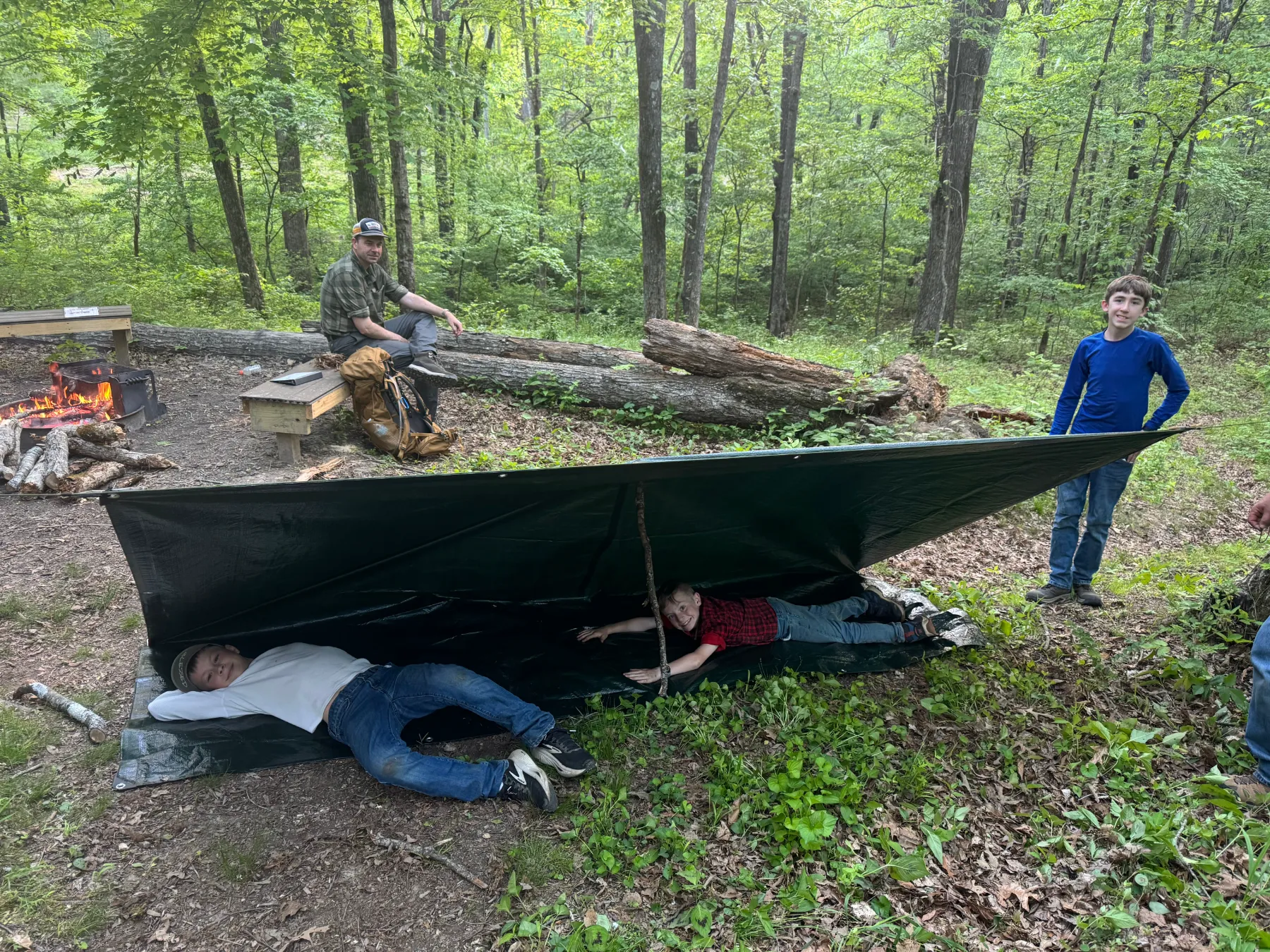
There is a small, practical confidence that comes from knowing how to tie a proper knot. A boy who can secure a canoe to a truck, rig a tarp in the rain, or throw a line to someone in trouble is useful in a way that other boys are not. Knots also teach the virtues of precision: a knot is either tied correctly or it is not, and the difference only shows up when it matters most.
Here are six knots every boy should know, what each is for, and how to teach them so they last a lifetime. For step by step animations of each, Animated Knots is an excellent free reference to use alongside your own demonstration.
1. The square knot (reef knot)
What it is for: Tying two ends of the same line together around something, such as a bundle, a bandage, or a sail.
How to remember it: Right over left, then left over right. Tied correctly, the two loops lie flat and neat. Tied wrong, you get a “granny knot,” which slips.
The warning: The square knot is not a reliable way to join two separate ropes that will be under serious load. Teach him that a knot has a job, and that using the wrong knot for the job is how accidents happen.
2. The bowline
What it is for: A fixed loop at the end of a rope that will not slip or tighten. Use it to tie a line around a tree, to make a loop for a rescue, or to secure a boat.
How to remember it: The old rhyme still works: the rabbit comes out of the hole, goes around the tree, and goes back down the hole. The bowline is often called the king of knots, and a boy who can tie it quickly, even with his eyes closed, has mastered something real.
3. The clove hitch
What it is for: Attaching a rope quickly to a post, pole, or rail. Useful for starting lashings and for temporary tie ups.
How to remember it: Two loops, the second crossing over the first, pulled tight. It is fast to tie and fast to adjust, but it can work loose if the load shifts, so it is best for temporary jobs.
4. Two half hitches
What it is for: Securing a rope to a ring, post, or tree, especially when tying up a boat or a hammock.
How to remember it: Wrap the rope around the post, make a half hitch around the standing line, then make a second one in the same direction. Simple, strong, and easy to untie.
5. The taut-line hitch
What it is for: An adjustable loop that holds under tension but can be slid to tighten. It is the camper’s knot for tent and tarp guylines, since you can tighten the line after the rain loosens it.
How to remember it: Around the stake, then two wraps inside the loop, and a final wrap outside. Once he sees it hold, and then slide when he wants it to, he will use it every trip. Animated Knots presents a closely related version as the Midshipman’s Hitch.
6. The figure eight
What it is for: A stopper knot at the end of a rope to keep it from pulling through a hole or a device. Its looped version, the figure eight loop, is widely used in climbing. Any climbing use, of course, should be taught by a qualified instructor.
How to remember it: It looks like the number eight. That makes it easy to check at a glance, which is exactly why climbers trust it.
How to teach knots so they stick
Teach one knot at a time. Master one before moving on. A boy who half knows six knots knows none.
Give him his own rope. A short length of good rope, kept in his pocket or his pack, turns idle minutes into practice.
Tie it blind. Once he can tie a knot, have him tie it behind his back or with his eyes closed. That is how he will need to tie it in the dark or the rain.
Use it for real. Knots learned in the living room are forgotten. Knots used to hang a food bag, tie down a canoe, or pitch a tarp are remembered forever. Our guides to a father-son camping trip near Nashville and canoeing near Nashville give him plenty of chances.
Make it a challenge. Time him. Race him. Let him beat you.
Why it matters
Knots are a small skill, but small skills are how boys become competent. A boy who has mastered six knots has learned that precision matters, that practice pays off, and that knowing how to do something useful makes him valuable to the people around him. For the broader case, see our essays on teaching a boy to work with his hands and teaching a boy to build a fire.