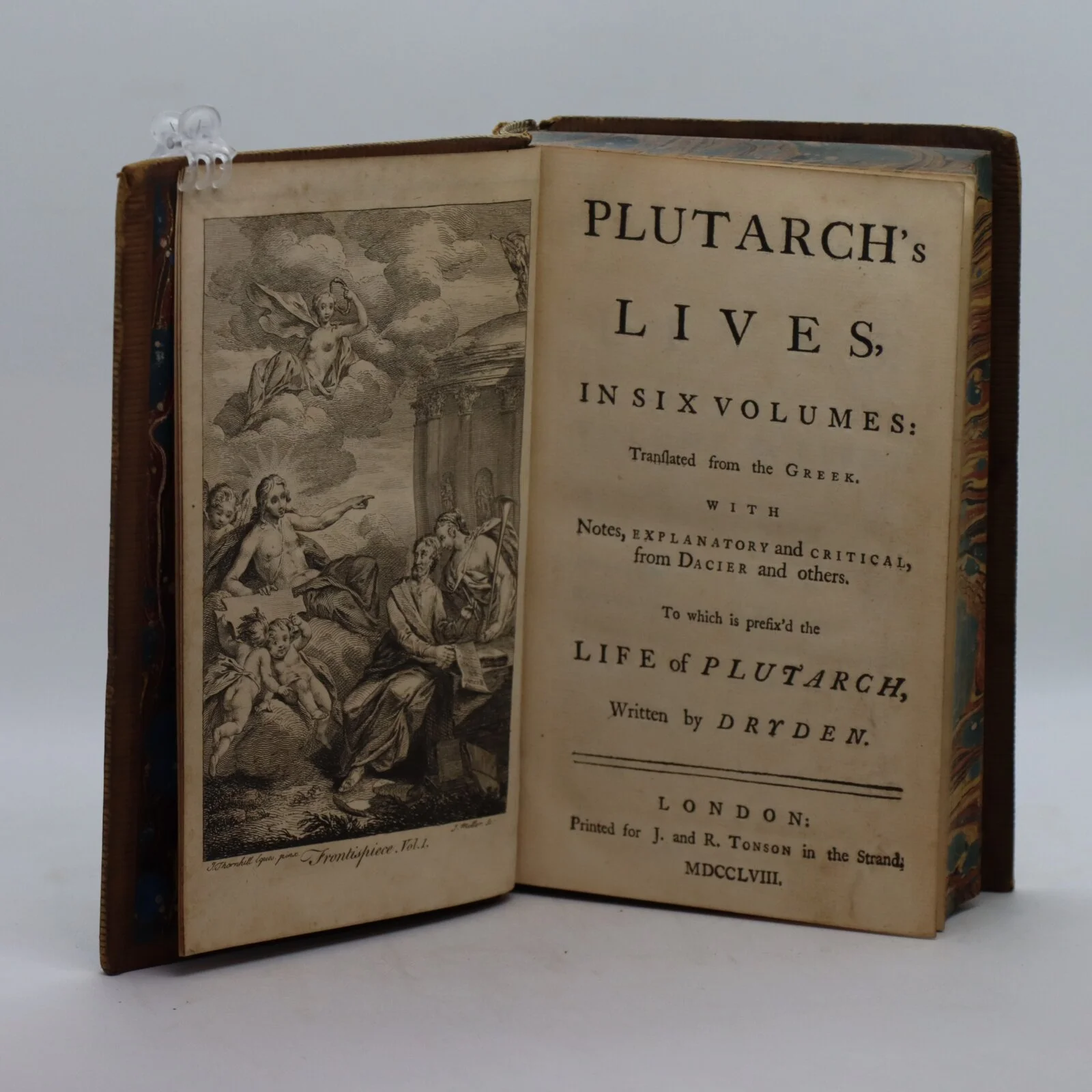
Few books have shaped the men who shaped the West as much as Plutarch’s Lives. Shakespeare built three plays on them. Montaigne kept them at his elbow. The American founders read them as boys and quoted them as men; when they argued about Rome, it was usually Plutarch’s Rome. For nineteen centuries, a young man who wanted to know what greatness and ruin looked like in a human life turned to Plutarch first.
Then, somewhere in the twentieth century, he dropped out of the curriculum, and most educated people today have never opened him. That is a loss, and an easily repaired one. Plutarch is more readable than his reputation, and he rewards a reader who knows a few things going in.
Who he was and what he wrote
Plutarch was a Greek, born around AD 46 in the small town of Chaeronea, who lived under Roman rule, held a priesthood at Delphi, and wrote in the decades around AD 100. His Parallel Lives pair a famous Greek with a famous Roman, Alexander with Caesar, Demosthenes with Cicero, and so on, usually followed by a short comparison. Twenty-three pairs survive, along with a few unpaired lives.
He tells you plainly what he is doing. At the start of the life of Alexander he warns the reader that he is writing lives, not histories, and that a small gesture or a joke often reveals a man’s character better than a great battle. That sentence is the key to the whole work. Plutarch is not trying to tell you what happened. He is trying to show you what kind of men made it happen, so that you can judge them and, in judging them, learn to judge yourself.
Which translation to use
The most widely available English version is the one made under John Dryden’s name in the 1680s and revised by Arthur Hugh Clough in the nineteenth century. It is vigorous, old-fashioned, and free of copyright, which is why it appears in inexpensive editions and in the Great Books of the Western World set. It is the one Meriwether’s book club uses, and its slightly archaic English suits the subject.
Readers who want something more modern will find good Penguin and Oxford translations of selected lives. Any of them will do. The important thing is to get a complete text rather than a book of excerpts, because the small details Plutarch prizes are exactly what excerpts cut.
Where to start
Do not begin at the beginning. The first lives, of Theseus and Romulus, are the most mythical and the least characteristic. Begin instead with the lives of men whose stories you already half know, so that the pleasure of recognition carries you.
Alexander and Caesar are the natural starting pair: two of the most famous men who ever lived, told with an eye for the moments that reveal them. Then Pompey and Cato the Younger, which together with Caesar tell the story of the Roman Republic’s collapse from three sides. Then Demosthenes and Cicero, the two great orators, whose lives are a study in courage and its failures. Pericles is the finest picture of statesmanship in the collection. Lycurgus and Numa show how two lawgivers tried to make whole peoples virtuous.
Our book club reads one life a week, in the order the volume prints them, and skips the comparisons; you can see the current reading calendar on the Gentlemen’s Classics Book Club page. Several of the lives are also published in full on this site, including Alexander, Pompey, and Phocion.
How to read him
Read for character, not chronology. Plutarch will sometimes skip years and then spend a page on a single dinner. Let him. The dinner is the point.
Watch for the turn. Nearly every life has a moment where a man’s virtue or his flaw becomes decisive. Plutarch rarely announces it. Find it yourself and ask whether you would have recognized it in your own life.
Read a life in one or two sittings. Most run between twenty and fifty pages. Reading a life whole preserves its shape; reading it in fragments across a week loses it.
Read with a pencil. Mark the sentences that judge, because Plutarch judges constantly and usually well. His asides on ambition, flattery, anger, and luck are among the wisest things in ancient literature.
Read with other men. Plutarch was written to be argued over. Was Caesar great or merely successful? Was Cato right? Did Alexander’s virtues cause his vices? Those questions have no settled answers and produce the best conversations we know. Our guide to starting a men’s reading group explains how to run one; if you are near Nashville or Chattanooga, you can simply join ours.
Why it still matters
Plutarch believed that reading about good men makes it easier to become one, and that reading about bad men, honestly told, makes it harder to become one without noticing. That is a claim about education, and it is the claim behind everything Meriwether Academy does, from the book club to the boys’ school we are working to found, where Plutarch will be read as he was for most of the last two thousand years: by young men, aloud, and in company. For the wider argument, see “What Makes a Great Book So Great?“