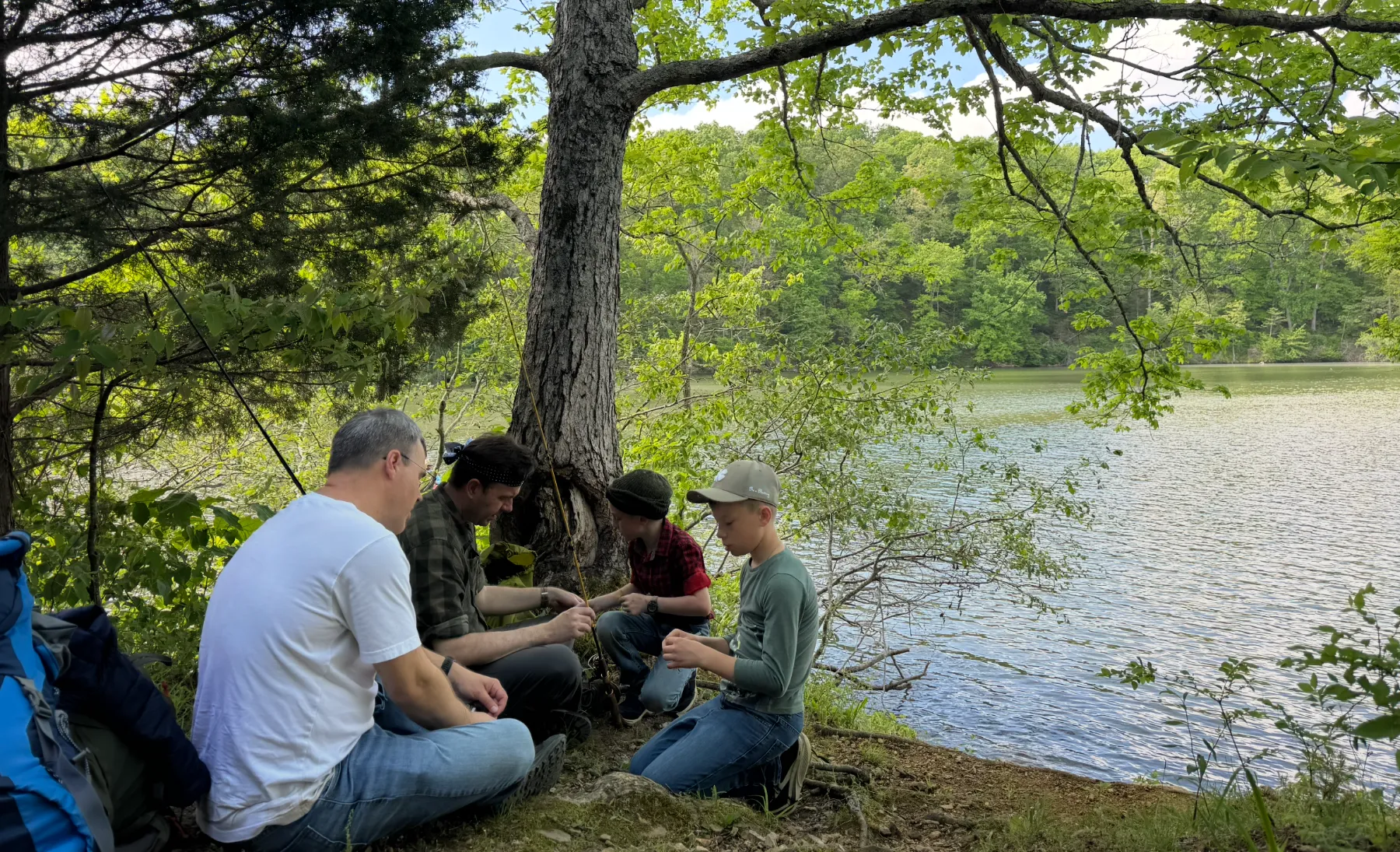
Few skills still pass from father to son the old way, by standing beside each other and doing it. Fishing is one of them. It requires patience, attention, some knowledge of the natural world, and a willingness to handle what you catch, and it produces long quiet hours in which a boy and his father can talk or not talk as they like. Around Nashville, it also requires very little travel.
The rules first
In Tennessee, anglers under 13 do not need a fishing license; from 13 through 15 they need a Junior license, which cost $9 plus processing fees as of 2026, and from 16 on a regular license is required, as it is for the father. Licenses are inexpensive and available online from the Tennessee Wildlife Resources Agency. Fishing for trout generally requires a trout add-on, such as the Annual Trout Supplemental, unless your license already includes trout privileges. Tennessee also holds a free fishing day each year, usually in June, when no license is needed, which makes a good first outing for a family that is not sure the hobby will take.
Check the TWRA regulations for size and creel limits on whatever you are fishing for. Teaching a boy to know and follow those rules is part of teaching him to fish.
Where to go near Nashville
The lakes. J. Percy Priest Lake, east of the city, and Old Hickory Lake, to the northeast, are the two big reservoirs closest to Nashville, with public boat ramps, bank access, and healthy populations of bass, crappie, catfish, and bream. Both have park land along their shores, and Long Hunter State Park on Percy Priest is a good place to start with a boy. Call the park before you go, since its fishing pier has been closed due to safety concerns.
The rivers. The Harpeth, the Duck, and the Buffalo all fish well for smallmouth bass and can be fished from a canoe or on foot at bridges and access points. Fishing from a canoe combines two of the best things a father and son can do together.
The tailwater. The Caney Fork River below Center Hill Dam, about an hour east, is the best-known trout water in Middle Tennessee, stocked by TWRA with rainbows, browns, and other trout from March through December. Trout fishing is more technical than bream fishing and better for an older boy, but a well-timed trip when the generators are off can be memorable. Check the generation schedule before you go; the river rises fast.
The ponds. Do not overlook a farm pond or a small neighborhood lake with permission. A pond full of bluegill is the best place in the world to teach a boy to fish, because he will catch something, and catching something is what keeps a boy coming back.
What he needs
A boy’s first setup should be simple and his own. A light spinning rod and reel, a small box of hooks, split shot, bobbers, and a few lures, a pair of pliers, and a stringer or small cooler. A pocketknife. A hat. That is all. Avoid buying serious gear until he has shown he will use it.
Live bait, meaning worms or crickets, catches more fish for beginners than anything else and teaches a boy where fish actually feed. Move to artificial lures when he is ready to be frustrated productively.
What to teach, in order
The knot. The improved clinch knot is the one to learn first. Make him tie it himself, every time, until he can do it with cold fingers. A boy who ties his own knots owns his own fishing.
The cast. Start in the yard with a practice plug. A boy who can put a bobber where he wants it will fish with confidence.
Patience. Fishing is mostly waiting, and a boy has to learn that the waiting is part of it. Do not fill the silence. Let him find out that a slow afternoon on the water is its own reward.
Handling the fish. Wet hands, a firm grip, hook out with the pliers, and either back in the water gently or onto the stringer. A boy should learn to respect the animal either way.
Cleaning and cooking. If you keep fish, he cleans them, with your hands over his the first time. Then he cooks them. A boy who has eaten bream he caught and cleaned himself has completed something that few of his classmates ever will.
Ethics. Follow the limits, take only what you will eat, leave the bank cleaner than you found it, and never crowd another angler. These are the manners of the sport, and they are worth teaching early.
The larger point
The fish are almost beside the point. What a father is really giving his son on those quiet mornings is his attention, a competence that will last a lifetime, and an early taste of the natural world as a place he belongs in rather than visits. It is the same thing we are after on every Meriwether trip.
For more of this kind of time, see our father-son activities around Nashville and our guide to a first camping trip near Nashville, where a rod belongs in the pack. Our canoe voyages on the Buffalo, most recently open to men and boys fourteen and up, are listed on the events page when scheduled.
From the Meriwether archive: Backpacking With a Teenage Boy: Pack Weight, Mileage, and What to Let Him Carry.