By Warren Steury
Sauntering through the redwoods of California, or the park-laden blocks of Savannah, or the towering porticos and dome of the U.S. Capitol, one is pressed with a palpable feeling. It is something that seems to transverse all of these widely different spaces, remaining unchangeable, pricking our hearts and leaving us thirsting for more. This instinct is not one of survival. One can live with all of the comforts and luxuries the world has to offer, and still be hungry with this deeply pressing desire.
That thing is Beauty.
What is Beauty exactly? I don’t know, but I think I can point it out when I see it. Ancient minds will tell you it is dependent on aesthetic proportion, these are our objectivists. Modern minds will tell you that beauty is in the eye of the beholder and there are no rules to it, these are our subjectivists. I will let the reader decide, from his years of watching the world turn, who is right and who is a liar.
For thousands of years humans certainly agreed with the objectivists. Greco-Roman architecture was done with precision, diligence, and devotion to the proper ratios and proportions devised by the ancient mathematicians. The Middle Ages were numbered with cathedral after cathedral erected across Europe, all following the same template and the same philosophy. That philosophy being; “there are rules to beauty.”

Subjectivists have taken their own shot at making things beautiful, with miserable results. With this slack in our principle, our standards dropped. Now city after city is filled with brutal, boxy, oppressive buildings. These buildings do not smile at you, do not invite you in, and do not acknowledge your dignity as a human being.
Our quest for beauty extends beyond buildings. A familiar example is in our daily dress. Why does every photograph from the 1950s back seem to us as ancient as Rome itself? What drove these men and women to carry themselves with such dignity and care in public? For one, a collective identity that everyone wanted to be a part of. It was a beautiful identity, filled with the pride and honor of being an American. Men wore suits, women wore dresses. There was an orderliness to that culture that has slipped away…

That beautiful orderliness is also exemplified in the art of courtesy and chivalry. Treating others with respect. Going out of our way to hold doors open for ladies. Helping those who are weaker and in need of help. Showing up like a member of a culture and not a transient independent passing in and out.
So why go through the extra effort to adorn a building with ornamental windows or put on a suit and tie at 7 AM? This part is important. Beauty requires effort. In this principle alone lies the hidden philosophy of the beautiful. When we take pride in our civilization we show up differently. We build buildings to stand for 1,000 years and not 30. We dress in a way that respects our own human dignity and the dignity of those around us who are forced to look at us. And we do all this because we understand the principle of reciprocity, energy in energy out.

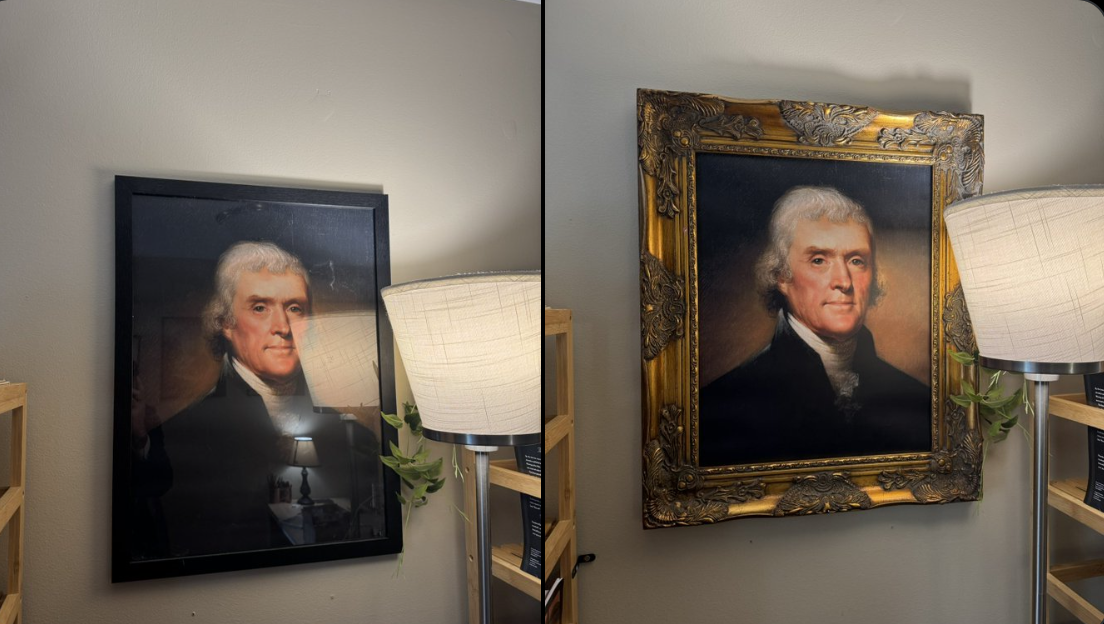
I can rant all morning, guys. I want you to all commit to three acts of beauty every single week. This weekend I was looking around my home and had the idea to make it more beautiful, so I put President Jefferson in a new frame. This is just a small example of how we can exercise our instinct for beauty in the world around us.
So three acts of beauty every single week, here’s a list of some things that come to mind that you may enjoy.
- Write a poem to your spouse or child.
- Wear a suit (or at least a coat and tie).
- Pick up some trash on your street.
- Attend a local government meeting and tell them the new building they want to force you to look at every single day on your drive to work is ugly and an eyesore.
- Plant flowers in your front yard.
- Decorate your home and office with inspiring and beautiful works of art.
Each of these things is a personal statement against apathy, idleness, lethargy, and ugliness. Most importantly, it is a protest against the standards this world wants to press upon you, and through acts of beauty we can transcend this fallen state of modern man and be a beacon of hope for those around us.
Respectfully,

Warren Steury
President, Meriwether Academy