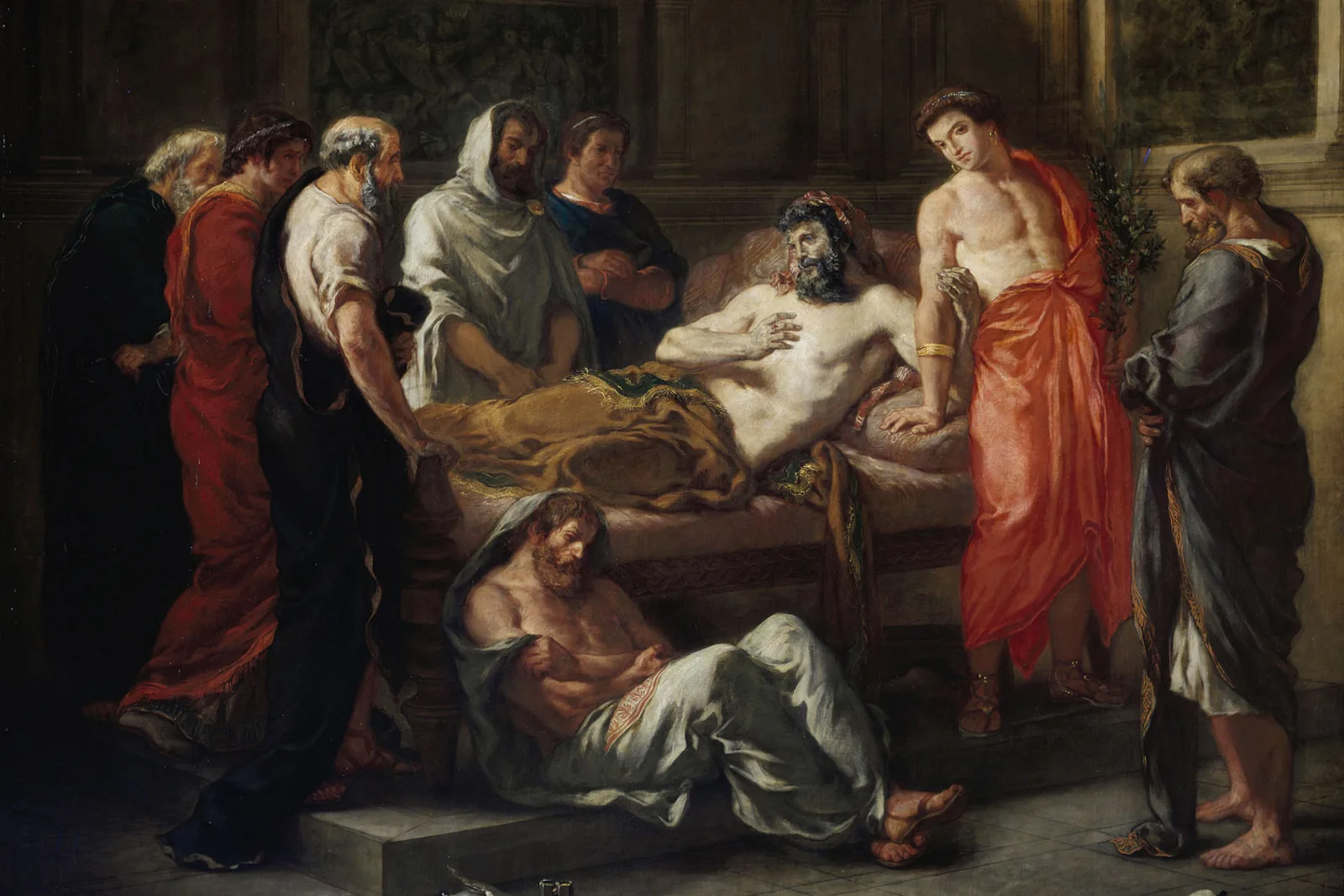
Walk into a bookstore and you will find Marcus Aurelius near the front, usually in several editions, often beside a shelf of modern books promising Stoic secrets for success. Young men are buying them. That is, on the whole, good news. A philosophy that teaches self-command, duty, and indifference to comfort is a better influence on an eighteen-year-old than most of what competes for his attention.
But the revival has a way of flattening the thing it revives. Stoicism has become, in places, a set of motivational slogans about controlling what you can control, detached from the demanding moral system it came from. A young man who wants what the Stoics actually offered should know what that was, and should know its limits.
What the Stoics taught
The school began in Athens around 300 BC with Zeno of Citium, who taught under a painted colonnade, the Stoa, that gave the philosophy its name. Its most influential surviving writers, though, are three Romans of the first and second centuries AD: Seneca, a statesman and adviser to Nero; Epictetus, a former slave who taught in exile; and Marcus Aurelius, an emperor who wrote a private notebook of exhortations to himself during military campaigns.
Their central claim is simple to state and hard to live. The only thing fully within a man’s power is his own judgment and choice. Everything else, including his health, wealth, reputation, and the behavior of other people, is outside his control and should not be the basis of his happiness. Virtue, meaning wisdom, justice, courage, and self-command, is the only real good. A man who has it is free regardless of his circumstances; a man who lacks it is a slave regardless of his.
From that follow the practices the Stoics are known for: examining one’s judgments, rehearsing misfortune so that it does not surprise, treating obstacles as material for virtue, and remembering death so as to waste less of life.
Why it suits young men
Adolescence is the age of caring intensely about things outside one’s control: what others think, whether one is liked, who wins. A philosophy that says those things do not determine your worth, and that your worth is determined by how you act, lands on a young man with the force of liberation. It is also a philosophy of duty. The Stoics were not hermits. Seneca governed, Marcus ruled, and Epictetus taught that a man’s roles as son, citizen, and friend were obligations to be fulfilled well. That combination of inner freedom and outer duty is precisely what a young man needs to hear.
What to read first
Begin with Epictetus, specifically the short handbook called the Enchiridion. It is blunt, practical, and can be read in an afternoon. The Discourses, transcribed by his student Arrian, go deeper in the same voice.
Then Marcus Aurelius, the Meditations. Read it slowly and not straight through; it was never meant to be a book. Gregory Hays’s translation is the most readable for a first pass.
Then Seneca’s Letters to Lucilius, which are the warmest and most literary of the three and the best on friendship, time, and how to face death.
Read them alongside the lives of men who practiced what they preached. Plutarch’s life of Cato the Younger, the Stoic who chose death rather than submit to Caesar, is the classic case study, and it is on our book club’s reading list this fall. A reading group of men working through these together will get more from them than a young man alone; our guide to starting a men’s reading group explains how.
What to watch out for
The popular version of Stoicism has a few failure modes, and a young man should be warned against them.
It can become an excuse for emotional coldness. The Stoics did not teach that a man should feel nothing. They taught that he should not be ruled by his feelings. Marcus grieved; Seneca wrote consolations to the bereaved. A young man who uses Stoicism to avoid loving anyone has misread it.
It can become mere self-improvement. The modern books often present Stoicism as a productivity system, a way to be calmer and more effective in pursuit of ordinary ambitions. The Stoics would have found that absurd. Their point was that ordinary ambitions are not worth pursuing at the cost of virtue.
It can become an excuse for passivity. “Accept what you cannot control” is true, but the Stoics were fierce about acting on what one can. Cato did not accept Caesar. He fought him to the end and died rather than yield.
And it has a real limit. Stoicism offers a young man a way to bear the world but little account of why the world is worth bearing, or what he is for beyond his own virtue. The Christian tradition, which absorbed a great deal of Stoic ethics, answers those questions in a way Stoicism cannot, and many young men who start with Marcus end up with Augustine. That is not a failure of Stoicism. It is the philosophy doing what it does best, which is to prepare a man for something larger.
Reading it with other men
The Stoics are best read in company, argued over, and tested against real lives. Meriwether’s Gentlemen’s Classics Book Club reads Plutarch’s Lives each week, several of them the lives of Stoics, and welcomes any man willing to do the reading. Our essay on why old books still matter makes the case for that kind of reading, and Emerson’s “Self-Reliance,” which we have published here, is a fine American cousin of the Stoic tradition.