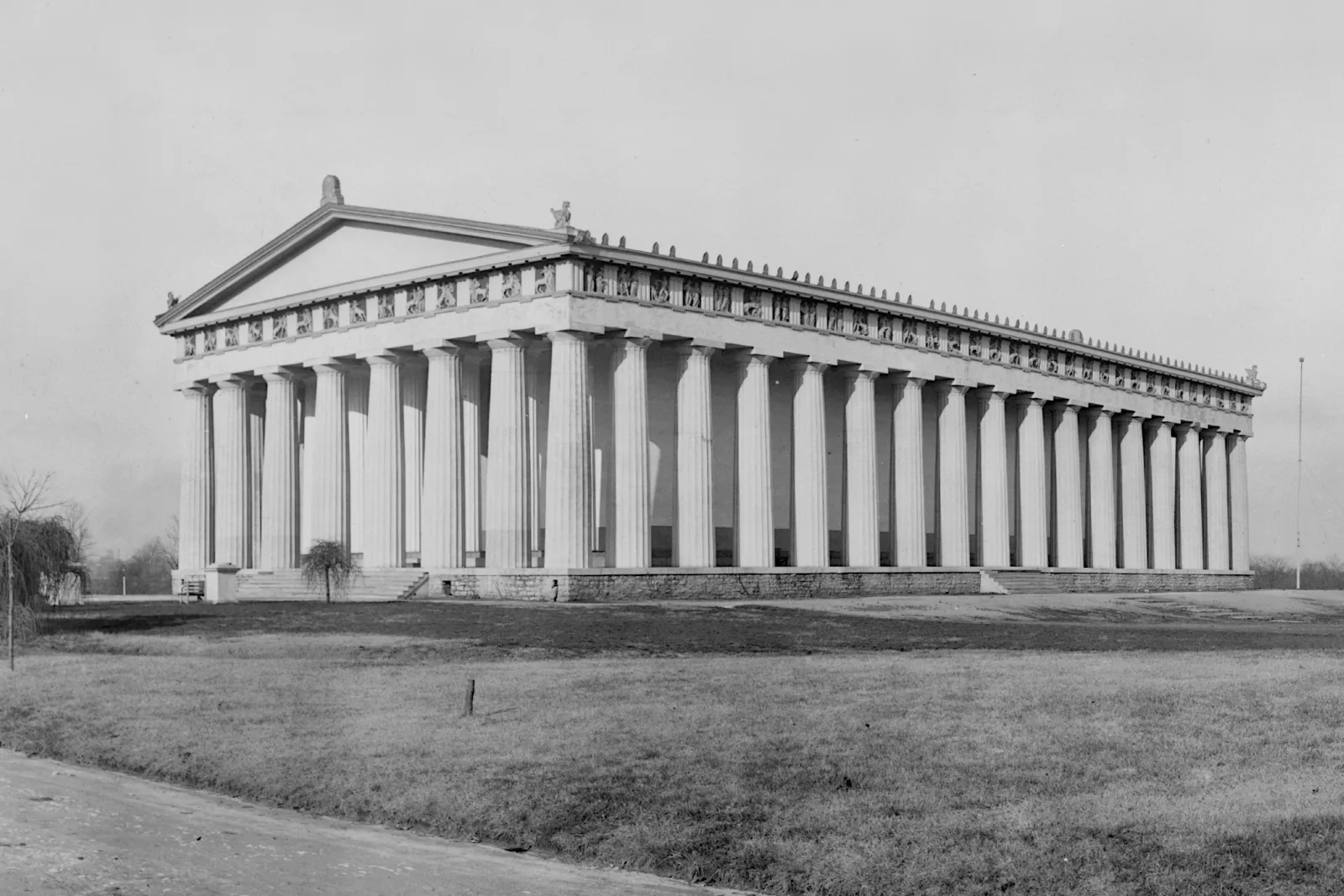
Every Nashville boy has seen it from the car window: a Greek temple in Centennial Park, just off West End. Fewer have been told why there is a Parthenon in Nashville at all. The answer is one of the best stories in the city’s history, and it makes a visit to the Parthenon a lesson in architecture, ambition, and what a city once believed about itself.
How Nashville became the Athens of the South
The nickname came before the building. According to the Nashville Public Library, Philip Lindsley, who came from Princeton to lead Cumberland College (later the University of Nashville), proposed in 1825 that the town become a center of learning for what was then the Southwest. Over time the phrase settled into “the Athens of the South.”
The city grew into the name. Between the 1860s and the early 1900s, institutions including Vanderbilt, Fisk, Meharry Medical College, and Peabody College opened here. The Tennessee State Capitol, finished in 1859, was built in the Greek Revival style. A city that thought of itself as a new Athens was always going to build a temple eventually.
The building itself
The Parthenon was built for the Tennessee Centennial Exposition of 1897 as a full-scale replica of the original in Athens. Like most exposition buildings, it was made of plaster, wood, and brick, and it was meant to be temporary. Nashvillians would not let it go. Beginning in 1920 it was rebuilt in concrete, with the exterior finished in 1925 and the interior in 1931.
Inside today:
- Athena Parthenos. Sculptor Alan LeQuire’s statue of Athena, unveiled in 1990 and gilded in 2002, stands about 42 feet tall. It is a reconstruction of the lost original by Phidias, and it is the single most arresting thing in the building.
- Casts of the Parthenon Marbles. Plaster casts taken from the original sculptures let a boy see, at close range, the figures that once decorated the temple in Athens.
- An art collection. The lower level houses 63 American paintings donated by James M. Cowan in the late 1920s.
Check the Parthenon’s own website for hours and admission before you go.
How to make the visit a lesson
A boy can walk through the Parthenon in thirty minutes and remember nothing. Or he can spend an hour and come away with a picture of Greek civilization he carries for life. The difference is preparation.
Before the visit, tell him about Pericles. The original Parthenon was built in the fifth century BC under the leadership of Pericles, who poured Athens’ wealth into public buildings. Plutarch describes the building program in his Life of Pericles, and it is short enough to read aloud in an evening. Ask your son whether Pericles was right to spend the city’s money on beauty. There is no easy answer, which is what makes it a good question.
At the columns, teach him the orders. The Parthenon is the most famous Doric temple in the world. Once a boy can tell Doric from Ionic from Corinthian, he will start seeing them on banks, courthouses, and churches all over Nashville. Our essay on the five orders of architecture is a good primer.
Under the statue, talk about scale. Athena is enormous on purpose. The Greeks built to make men feel small before something greater. Ask him how it feels to stand there, and why a city would want its citizens to feel that way.
Afterward, read the Funeral Oration. Pericles’ Funeral Oration, as Thucydides records it, is the best statement of what Athens believed it was. A teenage boy who reads it after standing in the Parthenon will understand it differently than one who reads it in a textbook.
What the building says about Nashville
The most interesting thing about the Parthenon is not that it is a copy. It is that a young Southern city, some thirty years after a devastating war, decided that the best way to celebrate itself was to rebuild the greatest monument of classical civilization at full size. Then, when the copy started to crumble, it spent a decade rebuilding it properly.
That tells a boy something. Beauty is not a luxury a civilization gets around to after the practical work is done. People have always treated it as part of the practical work, a statement of who they are and what they intend to become. It is worth asking him what our own buildings say about us.
Carry it further
Nashville’s classical heritage does not stop at Centennial Park. The State Capitol, the Hermitage, and dozens of older churches and homes carry the same Greek vocabulary. Meriwether Academy recently hosted Justin Shubow at the Belmont Mansion for an evening on civic design and beauty, and our events page lists what is coming next.
For the larger argument about why Greek and Roman civilization belongs at the center of a boy’s education, see our essays on why boys should study Western civilization and what classical education is.