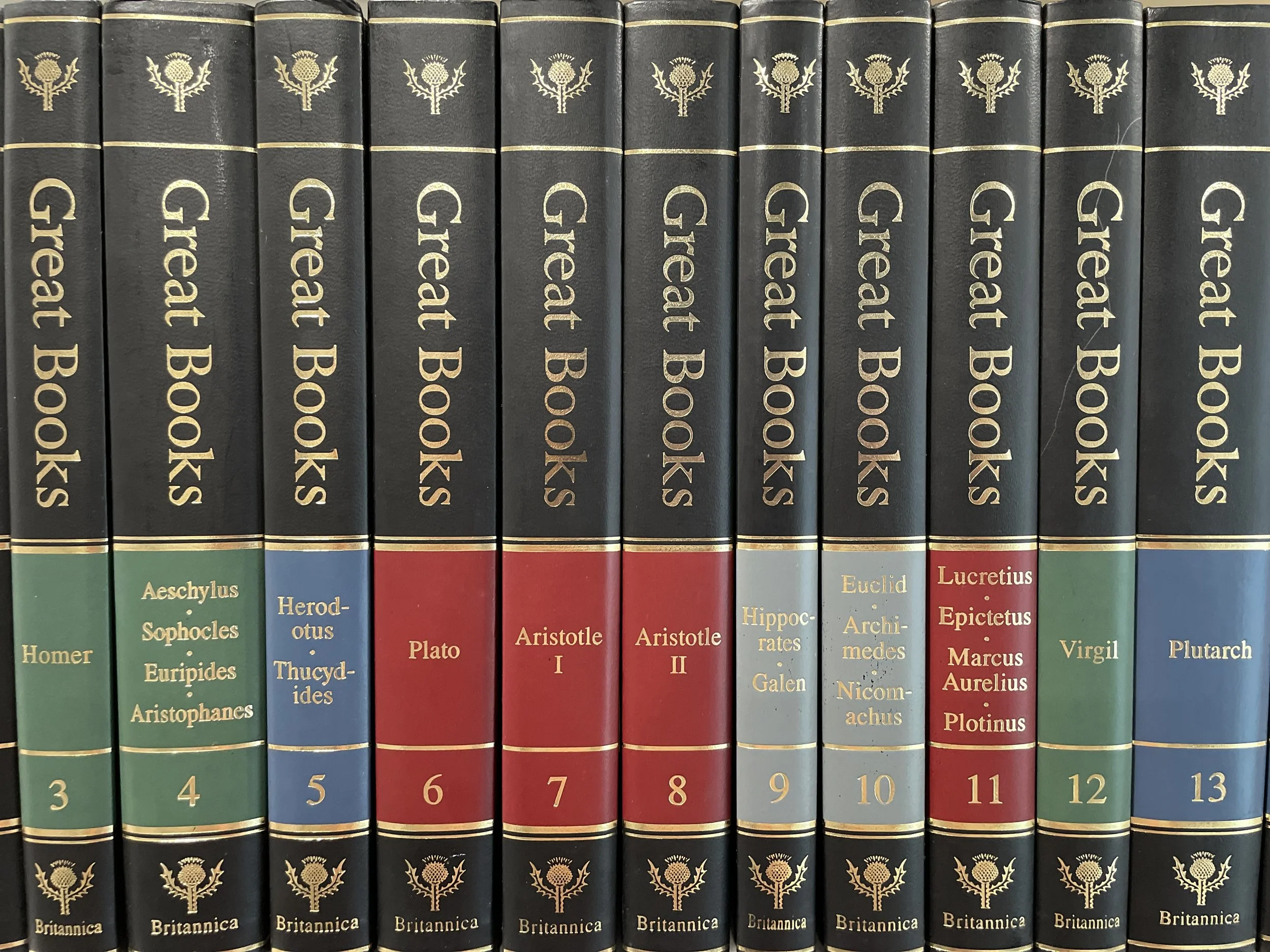
The idea sounds almost too simple to be a philosophy of education: instead of reading textbooks about the great thinkers, read the great thinkers. Instead of a chapter on Plato, read the Republic. Instead of a summary of the American founding, read the Declaration, the Constitution, and the Federalist Papers, and then argue about them with other people who have read them too.
That, in short, is a Great Books education. It has a specific history, a specific method, and a specific set of strengths and limits, and a family considering it for a son, or a man considering it for himself, should understand all three.
Where the idea came from
Reading the classics directly is as old as education itself. Roman boys read Homer and Virgil; medieval students read Aristotle; the American founders read Cicero and Plutarch as schoolboys. What is newer is the deliberate program built around a list.
That began at Columbia University after the First World War, when the professor John Erskine started a course in which students read one great book a week and discussed it in small groups. His students included Mortimer Adler, who carried the idea to the University of Chicago in the 1930s under its president Robert Hutchins. In 1937, two of Hutchins’s allies, Stringfellow Barr and Scott Buchanan, rebuilt St. John’s College in Annapolis around a four-year curriculum consisting entirely of great books, read in roughly chronological order. St. John’s still runs that way, on two campuses.
In 1952, Hutchins and Adler published the Great Books of the Western World with Encyclopaedia Britannica, a fifty-four-volume set meant to bring the program into ordinary homes. Adler spent the rest of his long life arguing that the books belonged to everyone, not just to universities. Our book club reads Plutarch in the Dryden translation from that very set.
What the method actually is
Three features distinguish a Great Books program from ordinary literature or history courses.
The first is primary texts only. Students read the works themselves, in full where practical, and secondary commentary is kept to a minimum. The conviction behind this is that a careful reader can understand Aristotle without a professor explaining Aristotle to him, and that the struggle of doing so is where the education happens.
The second is seminar rather than lecture. Students sit around a table, usually with a tutor who asks questions rather than delivering answers, and work out together what the text says and whether it is true. Nobody can hide. A student who has not done the reading is found out within minutes, and a student who has done it carefully can hold his own against anyone at the table.
The third is the conversation across centuries. Because the books are read in order, students watch later authors answer earlier ones. Augustine argues with Plato; Locke argues with Hobbes; the American founders argue with all of them. The tradition stops being a museum and becomes a live debate that the student is now part of.
What it does well
Men who went through a Great Books program tend to say similar things about it afterward. They learned to read slowly and closely. They lost their fear of difficult texts. They became comfortable disagreeing with authority, including the authority of the great authors themselves, because they had done the work of understanding first. And they acquired a shared frame of reference with everyone else who has read the same books, which turns out to be a large and interesting company across history.
It also suits boys and young men particularly well, in our experience, because it treats them as capable of serious thought and puts their competitive instincts to work in argument rather than against the classroom. We have written about what makes a great book great and about why old books reward the effort.
What it does not do
Honesty requires noting the limits. A pure Great Books curriculum offers little in the way of modern science, mathematics beyond Euclid and a few later figures, or practical and technical subjects. St. John’s includes laboratory science and mathematics, but a student who wants to be an engineer will need more. The canon is also, by design, Western, and mostly older than the twentieth century; the program makes no apology for that.
And the method depends entirely on the quality of the conversation. A seminar led by a poor tutor, or filled with students who have not read, is worse than a good lecture. The Great Books are not magic. They are an occasion for serious thinking, and the thinking still has to be done.
Who it is for
A Great Books education is a good fit for a student, of any age, who is willing to read hard things and argue about them in good faith. It does not require prior knowledge. It does require patience and a certain stubbornness.
For a boy in high school, a classical school with a strong reading list and real seminars gives much of the experience; our explanation of classical education describes what to look for. For a grown man, the easiest way in is a reading group that works through the books together. That is what Meriwether’s Gentlemen’s Classics Book Club does, one life of Plutarch each week, and it is free to join. If you have never read a great book with other men around a table, that is the place to find out what the fuss is about.