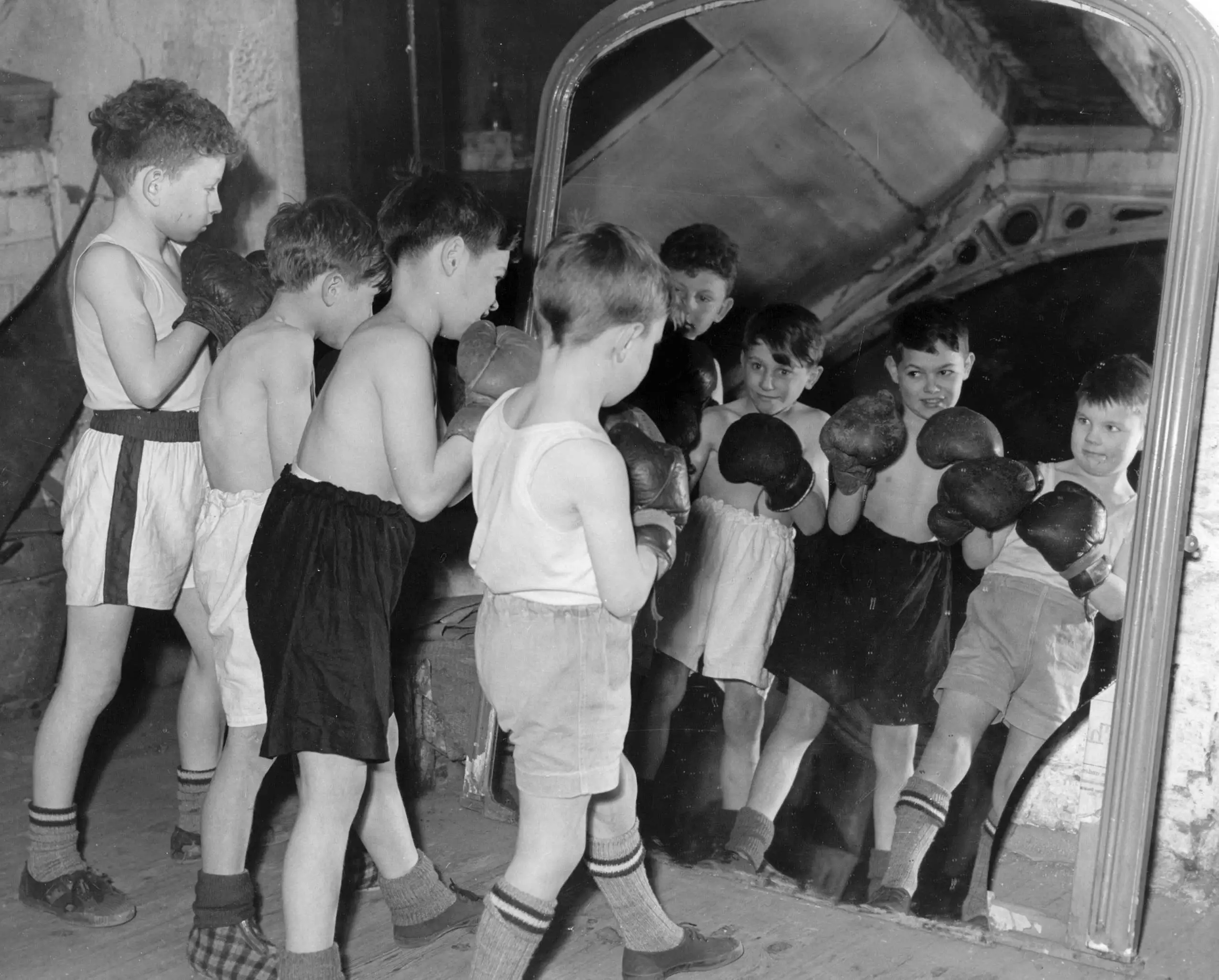
Ask a man who boxed as a boy what it gave him and he will rarely mention fitness first. He will talk about the first time he got hit hard and discovered he could keep going. He will talk about learning to stay calm when someone was trying to hurt him. He will talk about his coach, and about the strange respect that grows between two people who have traded punches under rules and shaken hands afterward.
Those are not incidental benefits. They are the reason the oldest educational traditions in the West put fighting next to philosophy, and why we have made boxing one of the three pillars of the school Meriwether Academy is working to found.
The old pairing of mind and body
The Greek gymnasium was not a gym in our sense. It was a place where boys wrestled, boxed, and ran, and also where they were taught music, poetry, and, in time, philosophy. Plato’s Academy took its name from a gymnasium, and tradition holds that Plato himself wrestled in his youth. The Greeks did not see the body as a distraction from the education of the mind. They thought a man who could not govern his body under stress could not be trusted to govern anything else.
Thucydides gave the idea its sharpest form: the society that separates its scholars from its warriors will have its thinking done by cowards and its fighting done by fools. Theodore Roosevelt, who boxed at Harvard and kept sparring as president until a blow damaged his eye, said similar things in plainer American. His essay “The Strenuous Life,” which we have published here, is the classic statement.
What boxing teaches that other sports do not
Most team sports teach cooperation, discipline, and the acceptance of a coach’s authority. Those are valuable, and we are not arguing against them. But boxing teaches a few things that are hard to learn anywhere else.
Composure under threat. A boy in the ring has to think while another person is trying to hit him. The first instinct is panic; the second is rage. Neither works. What works is a kind of calm attention that has to be learned, and once learned it transfers to every other frightening situation a man will face.
Honest feedback. Boxing does not allow a boy to lie to himself. If his guard is down, he gets hit. If he did not train, he gets tired in the second round and everyone can see it. There is no rubric and no participation trophy, which is exactly why boys trust it.
Respect. It is nearly impossible to spar regularly with someone and hold him in contempt. Boxers are famously courteous to each other for this reason. A boy who has been on the receiving end of a good punch learns quickly what it means to hurt someone and becomes less likely, not more, to do it outside the ring.
Restraint. Perhaps the most counterintuitive lesson is that boxing makes boys less violent. A boy who knows he can fight has nothing to prove. The boys who start fights at school are very often the ones who have never been in a real one.
Answering the obvious objection
Parents worry, reasonably, about head injuries. The concern is legitimate and should shape how a boy trains. The answer is not to avoid the sport but to do it properly: a good gym, headgear and proper gloves, sparring only when he is ready and only under supervision, and an emphasis on technique and fitness rather than on taking punches. Most of a boxer’s training is bag work, footwork, conditioning, and drills. Hard sparring is a small fraction of it and can be limited further for teenagers. A boy who trains for years and competes rarely, or never, still gets nearly everything the sport has to offer.
Wrestling and Brazilian jiu-jitsu offer many of the same lessons with less risk to the head, and for some families they are the better choice. What matters is that the boy learns to fight under rules, with a coach he respects, against opponents who are trying.
What to look for in a gym
The coach is everything. Visit, watch how he speaks to the boys, and notice whether the older fighters in the gym are the kind of men you want your son to imitate. Good boxing gyms are often quietly excellent at forming young men, and they are usually less expensive than organized youth sports.
Ask how the gym handles beginners and when sparring starts. A gym that puts a fourteen-year-old in the ring in his second week is not one you want. Ask about equipment, supervision, and how many coaches are on the floor. And ask your son afterward how he felt walking in. Some intimidation is healthy. Fear of the coach is not.
The larger point
We do not want boys to box so that they can win fights. We want them to box because a boy who has learned to keep his head while being hit, to respect the man across from him, and to hold his own strength in reserve has learned something about being a man that no lecture will teach him.