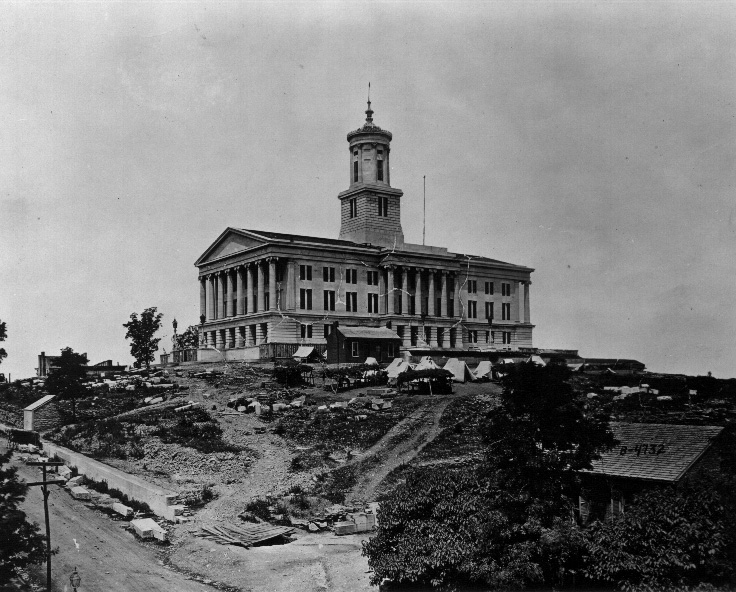
There is a building in downtown Nashville where the architect is sealed inside the walls, a president and his wife are buried on the lawn, and the tower is copied from a monument that has stood in Athens for more than two thousand years. Admission is free. Most Nashvillians have never been inside.
The Tennessee State Capitol is one of the best places in the city to teach a boy that buildings mean something, and a free Tennessee State Capitol tour makes it easy.
Planning the visit
According to the Tennessee State Museum, which runs the tours, the Capitol is open Monday through Friday, 9 a.m. to 4 p.m., and closed on state holidays. Free 45 minute guided tours start at 9, 10, and 11 a.m. and at 1, 2, and 3 p.m., first come, first served, at the first floor information desk. Self guided visits are also free. Groups of ten or more should book ahead. Large bags and backpacks are not allowed, and all bags go through security.
A Capitol visit pairs naturally with the free Tennessee State Museum at the foot of the hill, and with the Fort Nashborough site on the riverfront, where the city began. Our account of the founding of Nashville is good reading the night before.
What to point out
The Greek temple on the hill. The Capitol was designed by the Philadelphia architect William Strickland in the Greek Revival style and built between 1845 and 1859, according to its history. Walk around the outside first. Its porticoes draw on the Erechtheion on the Acropolis in Athens, with Ionic columns, the ones with scroll shaped capitals. Ask your son why a young state on the frontier would choose to house its government in a building that looks like an ancient temple.
The tower. The cupola atop the Capitol is modeled on the Choragic Monument of Lysicrates, a small monument erected in Athens in the fourth century BC to celebrate a victory in a choral competition. Look up a photograph of the original and compare. Then ask him what it says about a people that they borrowed their most prominent symbol from Athens, not Rome or London.
The architect in the walls. Strickland considered the Capitol his greatest work. He died in 1854, before it was finished, and was entombed within the building’s walls. That is an unusual kind of devotion to a building, and a boy will remember it.
The president on the lawn. James K. Polk, the eleventh president, and his wife Sarah were reinterred on the Capitol grounds in 1893. Polk is one of the least known presidents to most Americans, and he presided over the expansion of the country to the Pacific. The tomb is a good place to ask what makes a president memorable or forgotten.
How it was built. The Capitol was built from limestone quarried nearby, with labor that included convicts and enslaved men. A boy should know that too. Great buildings have builders, and not all of them chose the work.
A lesson in the orders
The Capitol is a perfect place to teach the classical orders of architecture. Before you go, read our essay on the five orders of architecture. On site, make it a game: who can find Doric, Ionic, and Corinthian columns first, on the Capitol and on the buildings around it. Once a boy knows the orders, downtown Nashville becomes a field guide.
From there, it is a short drive to the full scale Parthenon in Centennial Park, which completes the lesson: the same Greek vocabulary, used a half century later, for a different purpose.
Why it matters
Americans of the nineteenth century built their public buildings to say something about who they hoped to be. They chose Greek forms because they thought of themselves as heirs to the first democracy and the classical ideal of self government. Whether they lived up to it is a fair question, and a good one to ask on the steps.
A boy who learns to read buildings will never walk through a city the same way again. He will see arguments in stone where others see only walls. For the larger case, see our essays on why boys should study Western civilization and the heroic statuary of the U.S. Capitol.