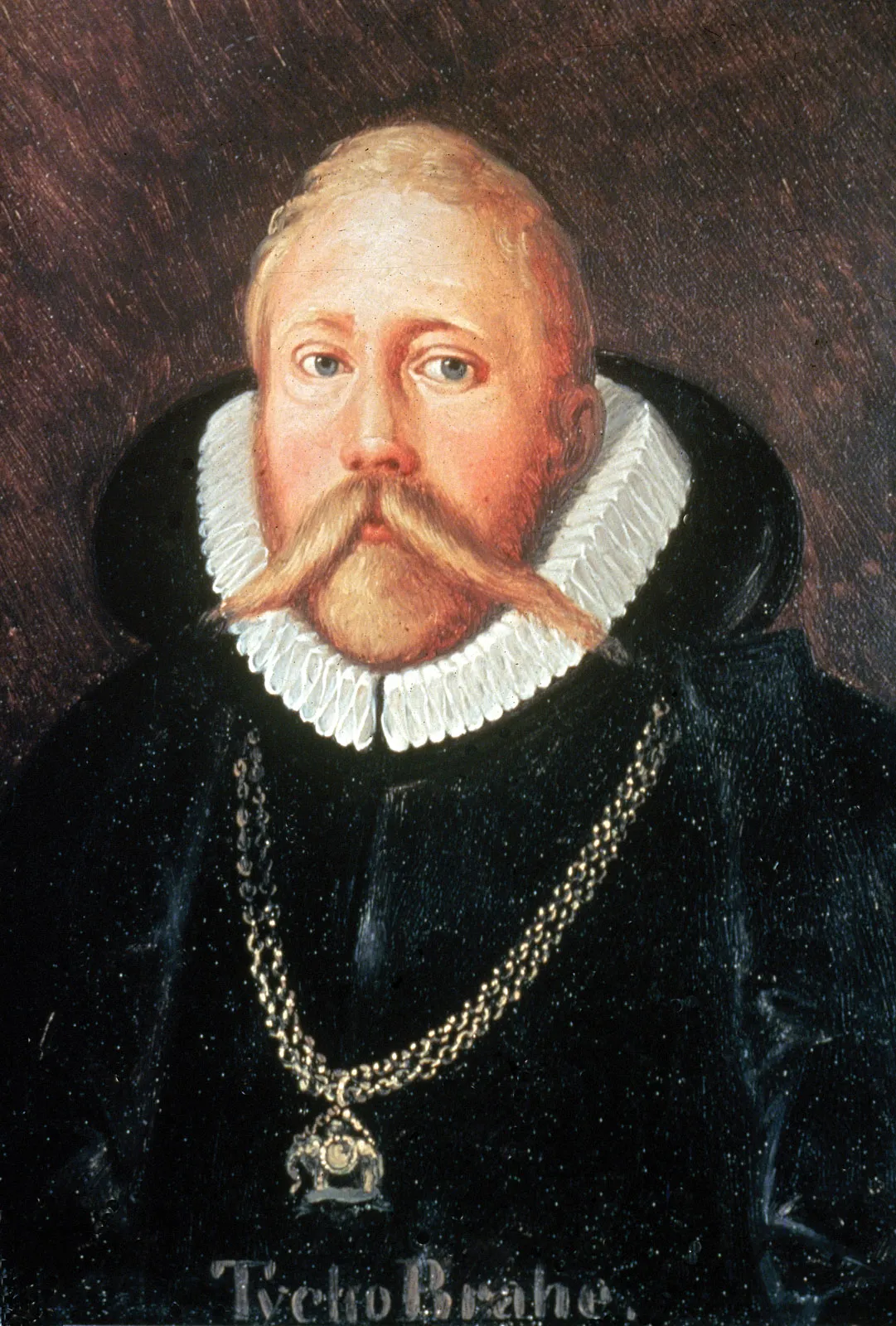
At Meriwether Academy, we speak often of the Renaissance man—filled with eccentricities and an unquenchable thirst for knowledge. Few figures in history exemplify this ideal quite like Tycho Brahe: a nobleman, an astronomer, a duelist, and a man with a brass nose.
Born in 1546 into Danish nobility, Tycho Brahe is remembered today as one of the most influential astronomers in history. But his contributions to science are only half the story. The other half is the man himself—flamboyant, obsessive, utterly brilliant, and gloriously peculiar.
In his early twenties, Tycho fought a duel with another Danish nobleman. The cause? A disagreement over a mathematical formula during a wedding feast. The result? Tycho lost part of his nose. From then on, he wore a prosthetic—first of brass, later of silver and gold—secured with paste and reportedly carried different ones for different occasions. The man was, in a word, unforgettable.
But Tycho wasn’t just eccentric for flair. He was fiercely devoted to the pursuit of knowledge. In an age before telescopes, he made the most accurate astronomical observations ever recorded by the naked eye. How? Through meticulous craftsmanship, an obsessive attention to detail, and a lifetime spent staring at the heavens from the observatory he had built himself—an astronomical fortress called Uraniborg on the Danish island of Hven.
There, Tycho created a small intellectual kingdom. He employed dozens of assistants, scholars, and craftsmen to help chart the stars with unprecedented precision. He built enormous instruments—quadrants, sextants, armillary spheres—all hand-crafted and calibrated to measure the position of planets and stars to within a fraction of a degree. For nearly 20 years, he and his team cataloged the cosmos, night after night, season after season.
All this from a man who still held fast to certain medieval beliefs. He rejected the Copernican model of the solar system (where the Earth orbits the sun), instead proposing his own hybrid system where the sun orbited the Earth—but the other planets orbited the sun. He was wrong, yes—but not foolish. His data would later be inherited by Johannes Kepler, who used it to develop the laws of planetary motion that we still use today. Without Tycho’s relentless documentation, Kepler’s discoveries might have taken centuries longer.
But perhaps what makes Tycho most worthy of our attention at Meriwether is not just his scientific legacy—it’s the spirit behind it. Tycho was a man of conviction. He did not wait for someone to hand him a telescope; he invented his own tools. He did not ask for a classroom; he built an observatory with his bare hands and a nobleman’s fortune. He had a temperament that many today might find difficult—vain, combative, extravagant—but it was precisely this fire in his belly that fueled a lifetime of devotion to the pursuit of truth.
At Meriwether Academy, we are a brotherhood of men reconnecting with their elemental potential—to be both the man in the woods and the man under the stars. To think deeply, to live boldly, and yes, to embrace a little eccentricity in the name of greatness. Tycho Brahe reminds us that the road to brilliance isn’t always tidy. It doesn’t require perfection. But it does require vision, intensity, and the willingness to do things a little differently.
So, next time you look up at the night sky, remember the gold-nosed nobleman who mapped the stars with callused hands and an unshakable will.
That’s the kind of man we study—and the kind we aim to become.