By Nick Gallo June 18th, 2025
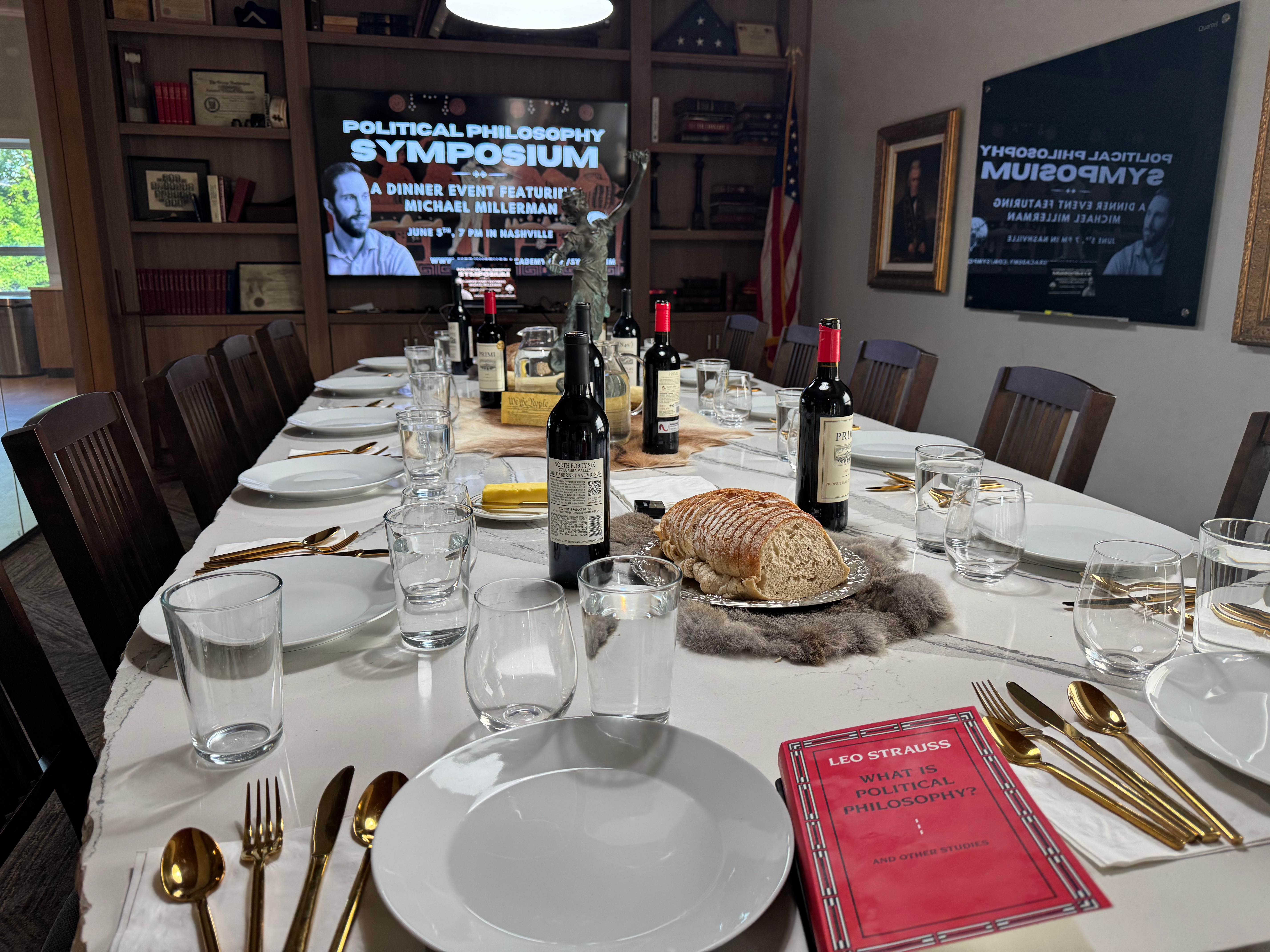
Excellent discussion with Michael Millerman at the Meriwether Academy symposium dinner earlier this month!
As many of you know, I’ve had the privilege of working one-on-one with Michael over the past few years on many political philosophy and writing projects. I also recently connected with Meriwether here in Nashville. This was the first time bringing these two worlds together and it couldn’t have gone better.
Michael discussed Leo Strauss’ famous essay “What is Political Philosophy?”
What makes a human life good? What makes a political order good? While these may seem like esoteric philosophic questions, they are actually of central practical importance, as Strauss tells us.
Whether we know it or not, each of our political actions is guided by our opinion of the good: when we attempt to change a law, we do so because we believe the change will make our lives or country better—we are driven to do so by an (often unarticulated) opinion of what exactly “better” and “good” mean.
Political philosophy emerges when we attempt to transform our opinion of the good into knowledge of the good—through the difficult process of bringing our opinion clearly to light and then questioning it.
Strauss’ essay shows us how the greatest thinkers of all time—from ancient to modern political philosophers—have attempted to do just that. He alerts us to a crisis: the near-death of political philosophy today and discusses its causes as well as our possible paths forward.
Meriwether Academy brought together a group of twelve men for this engaging discussion. Many were new to these topics though several were active in contemporary politics and culture, including an editor of a local newspaper, a political consultant, a specialist in orthodox religious theology, and an author of a popular book on the dangers of modern technology.
What impressed me most about Michael when I first began dialoguing with him was the breadth of knowledge he’d bring in to answer my questions. This night was no different. Attendees’ questions spawned Michael’s many intriguing answers and follow up questions (based largely on Strauss’ analysis in this essay and in other texts) including the following:
➤ Why is Strauss such an important thinker? Strauss, through his many penetrating analyses, provides us with a uniquely deep and rich understanding of so many great thinkers, both ancient and modern.
➤ How have civilizations endeavored to define the good? How have the two roots of our tradition—the Biblical and the Greek—defined it differently?
➤ How did political philosophy transition from ancient to modern? Strauss provides a unique schema for viewing “modernity,” attributing the break to Machiavelli.
➤ Is political life seen most clearly through Plato and Aristotle? Do today’s many theories and terms distort our view of political life?
➤ Have we moderns properly thought through the arguments of the ancients? Or does even our use of certain terms, like “superstition,” when describing their beliefs reflect a mere propaganda victory of the moderns over the ancients?
➤ How can the problems of technology and transhumanism be understood within the trajectory of modern political philosophy? Hobbes’ political philosophy required constructing artificial islands of knowability (in contrast to the unknowability of nature). To confront today’s drive to create a fully digitized (hence, knowable) world, must we confront Hobbes’ philosophy?
➤ Should AI be “maximally truth seeking”? There is a fundamental tension between truth and justice, as articulated in Plato’s Republic.
➤ Is there a way to synthesize positive views of technology and spirituality? Rabbi Soloveitchik’s Lonely Man of Faith provides such a schema, one based on the dual account of Man’s creation in Genesis. The problem today is that tech impulses drown out man’s other half.
➤ How can we adopt the habits of the philosopher and cultivate virtue and wisdom in ourselves? The Great Books are the lifeblood of this quest. But we also need good friends to dialogue with—something special comes out in dialogue that you can’t predict or arrive at alone.
This was certainly the case that night. Throughout my short time with Meriwether I’ve been impressed with their ability to consistently bring together such high quality groups of men and speakers for events like these. Looking forward to many more!
For more info, check out these links to the full video, the Millerman School, and the Meriwether Academy.